

How Jodi Picoult Uses Fiction as Political Activism
/Jodi Picoult may be known as a bestselling author of popular fiction but her work does far more than entertain. Across twenty-nine novels including the recent number one bestseller By Any Other Name, Picoult has built a career out of tackling some of the most divisive issues in contemporary politics.
Her books ask readers to sit with difficult questions about reproductive rights, religion, race, sexuality and violence. These are topics many people actively avoid in nonfiction. Picoult uses her stories to spark conversations about complex issues, creating characters whose emotional depth helps readers lower their guard.

Picoult as the 2013 Harry Middleton Lecturer at the LBJ PRESIDENTIAL LIBRARY
How Picoult Mixes Entertainment and Education
Picoult understands that readers who would never pick up a political essay about abortion or racism can still be challenged through narrative storytelling. As she explained in an interview with Maclean’s, “nobody is going to pick up a non-fiction treatise on abortion. The beauty of fiction is that you’re reading it for entertainment. But if I’m doing my job right, you’re learning a lot along the way.” Her ability to drive narrative and create relatable characters allows her to reach readers who might otherwise refuse engagement with such topics. This is the core of her approach. Readers come for the plot and they leave with their worldview shaken, changed or at least questioned. It is also what makes her work so controversial; 19 Minutes, her novel about a school shooting, was recently named the most banned book in the United States according to PEN America.
Art Is Political
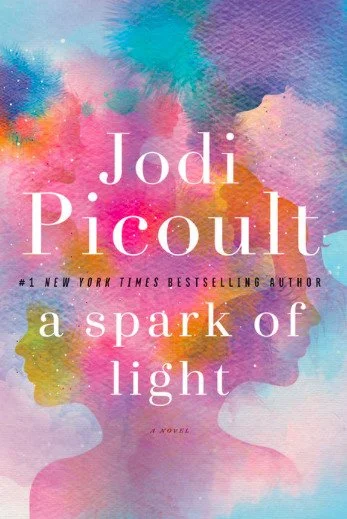
Book Cover For Picoult’s Novel “a Spark of Light”
Part of Picoult’s impact comes from her refusal to separate art from politics. She openly rejects the idea that storytelling should be neutral. As she told USA Today, “I honestly do not know of a single writer in my acquaintance who does not believe that all art is political.” When people claim books should not be political she argues that they often mean they want “stories that fit my worldview and my echo chamber.” Her novels intentionally disrupt that comfort. In A Spark of Light, for example, she presents the perspectives of everyone inside an abortion clinic during a hostage situation, from the shooter to the staff to the women seeking care. This structure makes it impossible for readers to retreat into familiar narratives or over-simplified moral positions.
Religion is another recurring force in Picoult’s writing. She has described religion as something “meant to unite, but that more often creates schisms,” noting that many political issues including abortion, reproductive rights, gay rights and the death penalty have ideological roots in beliefs that are “archaic or cherry picked.” In Change of Heart, she writes that religion “was supposed to be a blanket drawn up to your chin to keep you warm” but that it can leave people “shivering out in the cold” when rules become more important than compassion.
An Effective Approach
The controversy surrounding Picoult’s novels and the growing efforts to ban them prove how effective her approach is. Her fiction reaches people who resist political debate or who shut down when confronted with opposing arguments. By entering through emotion instead of confrontation, she encourages readers to engage with issues they might otherwise avoid. And when they turn the final page, they continue to think about what they have read.
Jodi Picoult is not simply writing bestselling novels. She is using popular fiction as a vehicle for political engagement, social critique and moral reflection. Her stories show that empathy can be a form of resistance and that sometimes the most powerful activism begins with a single character who refuses to let us look away.
About the Author

Évangéline Doucet is a professional translator turned writer, currently completing her final year in the Professional Writing program at Algonquin College where she has focused on honing her skills in editing, research, and digital communication. She is also a member of WordTonic, a global writing community where she is building her copywriting portfolio. When she’s not freelancing or studying, you can usually find her drafting essays and reflections on Substack, often inspired by literature, culture, and politics.