𝘠𝘐𝘐𝘒, or Why Impressions Matter in Storytelling

=""

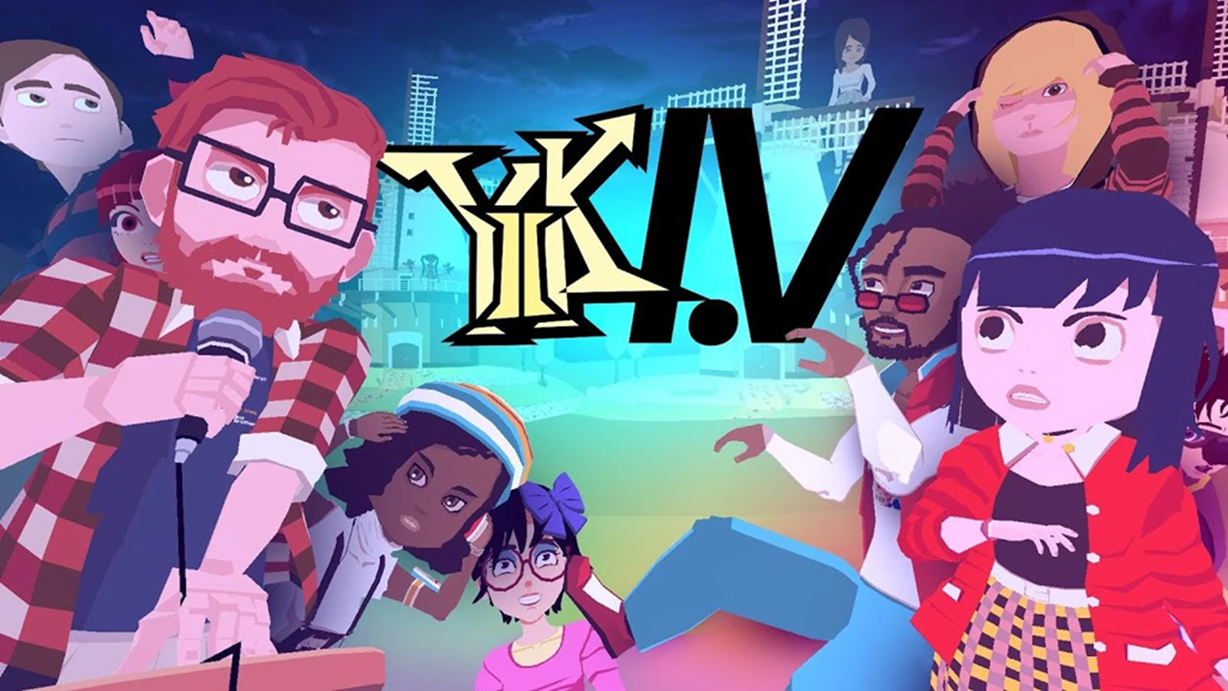
Image courtesy of ACKK Studios

If you were part of the indie game scene in 2019, you’ve probably heard of YIIK. It was mocked extensively, declared the worst game ever made and was followed by endless controversy — both genuine and fabricated. (I recommend reading this interview with Andrew Allanson, the co-creator of YIIK. It sheds some light on a few controversies and gives insight on the making of YIIK.) 

So it may come as a surprise that, in 2024, YIIK received a free, major overhaul (YIIK I.V), complete with a bundled-in sequel.

That begs the question: 

Is YIIK good now?

I wouldn’t call it good, but I thoroughly enjoyed it — ironically and unironically. YIIK I.V is an intriguing experience that is worth giving a shot. The same cannot be said for its original release (YIIK 1.0), which, while not the worst game I’ve played, is up there.

But instead of reviewing YIIK I.V, I’d rather talk about why I think YIIK I.V achieved what YIIK 1.0 didn’t, story-wise. Because here’s the thing: Almost all of YIIK 1.0’s script remains in the overhaul. Most changes impact how the original script is interpreted, rather than changing the script itself.

(Side note: There’s no need to have played either iteration to understand this blog post, but there’ll be some minor spoilers.)

Reasons why YIIK I.V’s story reads better: 

Additional content 

YIIK I.V adds lots of new content that supports the original script. 

For an early example: YIIK 1.0 opens with a scene of Alex getting off a bus, which gives the false impression of a grounded story. YIIK I.V opens with an extremely surreal sequence of events — and then cuts to the bus scene. This better primes a player’s expectations; YIIK isn’t a grounded story that you should blindly accept as presented. Like a dream, it needs to be analyzed and interpreted. 

It also makes it apparent that Alex is supposed to be unlikeable; in this sequence, before you even meet him, he is referred to as The Bad Brother.

Visual recontextualization 

Many scenes have been visually changed to better communicate ideas to the player.  

Take, for instance, Alex’s monologues: 
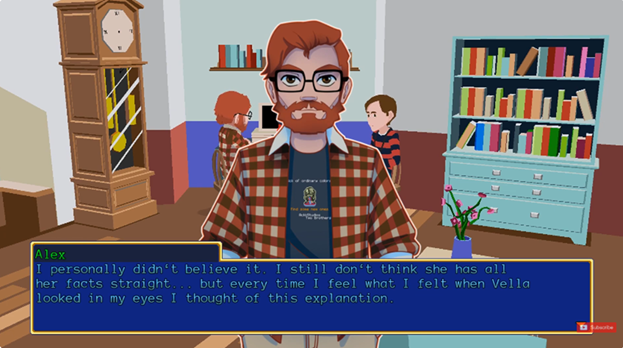
A screenshot of a monologue in YIIK 1.0. Michael and Alex sit by the computer in Alex's house. Alex's talksprite is laid over the scene; he faces the player while monologuing.

Image courtesy of ACKK Studios

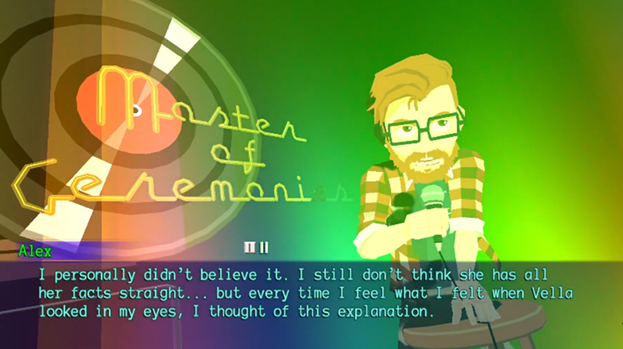
A screenshot of the same monologue, but in YIIK I.V. The game has cut away from reality. Alex is alone in a near-empty room. He leans over a stool, mic in hand, and monologues.

Image courtesy of ACKK Studios

Alex, a very unreliable narrator, monologues to the player throughout the game. By visually depicting these monologues as a performance in YIIK I.V, it clues the player to not take Alex at face value. 

Gameplay fixes

YIIK 1.0 was a slow, buggy mess, complete with a combat system that could’ve been fun if it were executed with grace — and it was not. 

It was glaringly sloppy.  

YIIK’s story can be hard to grasp and a lot of things intentionally don’t add up. I think because the gameplay in YIIK 1.0 was so bad, people were conditioned into thinking deliberate decisions were mistakes. 

For example: Alex states the year is 1999. In one conversation, Michael says that Lufia 2 is the holy grail of his youth, despite that game releasing in America in 1996. It was commonly believed that ACKK Studios didn’t bother looking this up.

But in that same conversation, Alex mentions Two Brothers, a game ACKK Studios released in 2013. Would they forget their own game was made over a decade later?
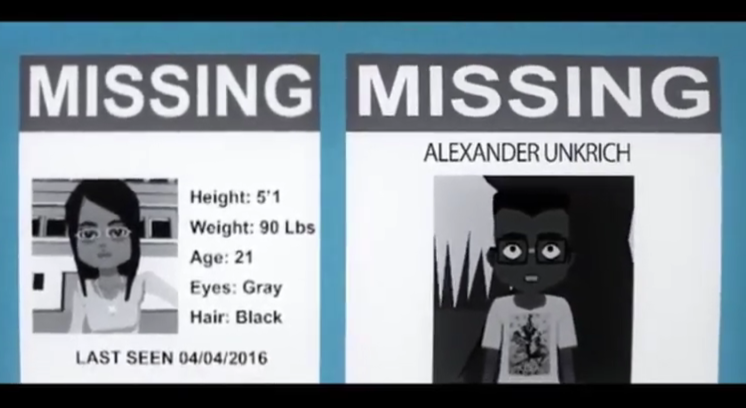
A screenshot depicting the missing posters of two characters. One poster has a section that reads: LAST SEEN APRIL FOURTH, 2016

In YIIK I.V, the true year (2016) is shown before Alex ever claims it’s 1999 —
image courtesy of ACKK Studios.

The anachronisms were deliberate, because the game doesn’t take place in 1999. Andrew Allanson elaborates on why this is in his not-so-spoiler-free Discord post.

But when the gameplay gave such a bad impression, can you really blame people for assuming the writing must’ve been just as sloppy?

YIIK I.V’s gameplay is a far cry from YIIK 1.0’s. It is fun, functional, and full of flare. This, combined with its hard lean into surrealism, makes it harder for players to write off the story’s strange choices as ‘just another sloppy decision’. 

The impression YIIK I.V couldn’t change

I mentioned the massive backlash YIIK got upon release. Such an infamous reputation makes people inclined to think poorly of YIIK, long before they ever play it. I sometimes wonder if I would’ve enjoyed YIIK more if I hadn’t heard of it beforehand.

It is unfortunate that YIIK was saddled with a reputation it only partially deserved. Despite the massive improvements in YIIK I.V, I doubt YIIK will ever escape that reputation. But we can at least learn one thing from YIIK: Impressions matter in storytelling. 


A close-up of a mole cricket on someone's finger.

(Photographed by Carol Wolf.)

The name is Mole Cricket. The world is a fascinating place when you’re cursed with sapience. I have too many thoughts in my mind and too much time on my claws. Without the need to work as my human peers must, I have endless time to devote to video games.

I first delved into the MOTHER series upon pupating, having heard of my kind’s inclusion in the series’ third instalment. It sparked my love for games and inspired many new gamedevs. My blog posts will examine games made by those devs over the decades.

I also graduated at the University of Texas with a masters in English. (The more impressive feat was not getting squashed by my squeamish classmates). You can follow me and my fellow bloggers here!

𝘓𝘐𝘚𝘈 𝘵𝘩𝘦 𝘗𝘢𝘪𝘯𝘧𝘶𝘭, or Making Meaningful Choices

The official banner of LISA the Painful. It depicts a man on a cliffside, with a mask in hand.

ONE MAN’S FUTILE QUEST. (IMAGE COURTESTY OF DINGALING PRODUCTIONS).

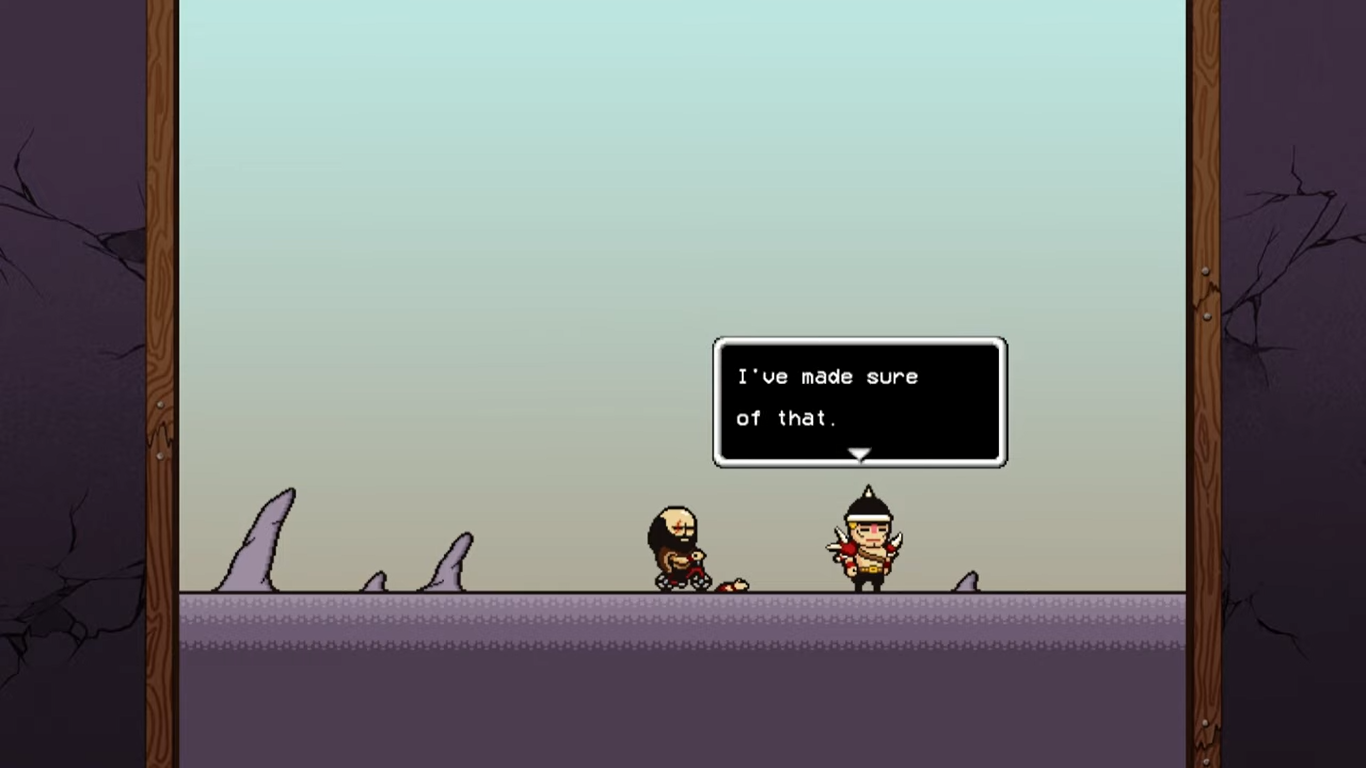
When we think about games with choices that matter, we often think about games with multiple endings, determined by our decisions. LISA the Painful, one of the lesser-known MOTHER-inspired games out there, has only one. In the sense of story outcome, your choices don’t matter. After all…

A screenshot from LISA the Painful. Above Buzzo is a textbox that reads, "I've made sure of that."

FROM THE MOUTH OF THE BASTARD HIMSELF. (IMAGE COURTESY OF DINGALING PRODUCTIONS.)

There are three brief post-ending sequences determined by your choices, but those aren’t different futures you’ve forged; they’re glimpses into the past.

And yet, the game is filled with choices that feel meaningful. As it turns out, choices don’t need to affect story outcome to be important.

How?

The choices in LISA the Painful may not affect the story’s conclusion, but it does two other vital things:

1.      It informs us of Brad’s character.

This might seem like a strange thing to claim. If Brad can make multiple choices, doesn’t that make his choices a stand-in for the player’s? Wouldn’t a more realised characterization of Brad not need player input?

And that is a reasonable thing to think. There is some variance on where Brad is on the selfish-selfless scale, depending on how you play him.

But the vast majority of choices Brad must make are forced upon him. And these decisions are not easy ones, as I’ll explain later.

Moreover, Brad doesn’t always listen to the player’s input. There are some impulses that are too deeply rooted in his pain and suffering to allow any room for rational thought or deviation. And it is in those moments of defiance that you are truly understand who Brad is. It is here that you learn of what choices he could’ve made, perhaps even wanted to make, but could not bring himself to make.

Perhaps more importantly, however:

2.      It changes our experience with the game.

LISA the Painful takes advantage of that fact that it’s a video game, achieving ludonarrative resonance (if you don’t know what that is, Capcom did an article on it). One of the many ways it does so is through its choices.

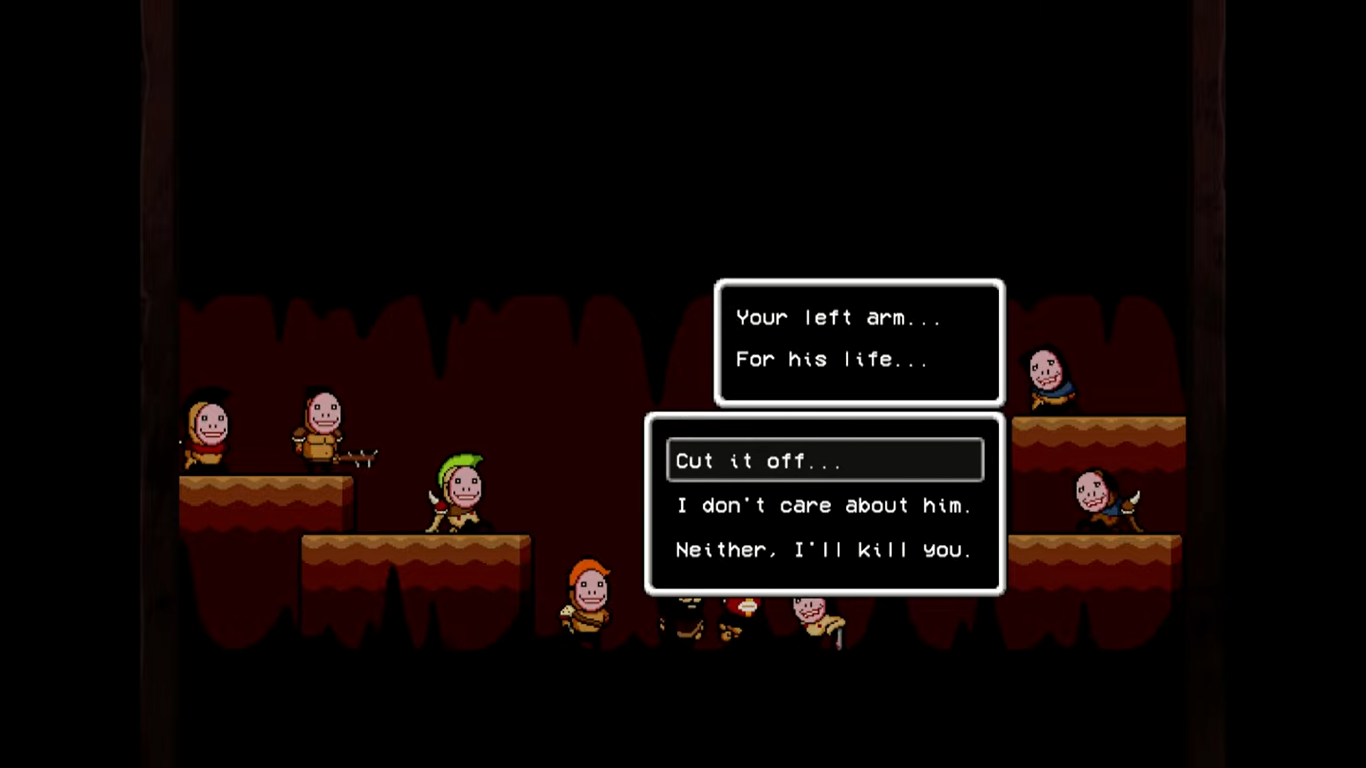
A screenshot of LISA the Painful. It depicts Brad Armstrong and Rage surrounded by The Joy Boys. A textbox reads, "Your left arm...For his life..." and the options are, "Cut it off...", "I don't care about him.", or "Neither, I'll kill you."

TWO TOUGH CHOICES AND ONE FALSE ONE. (IMAGE COURTESY OF DINGALING PRODUCTIONS.)

This is one of the earliest choices presented in the game.

I believe most players, myself included, quickly chose to give up our arm during our first playthrough. While these statistics don’t account for subsequent playthroughs, the fact that only 6.9 per cent of players have the Selfish achievement (which can only be gained if Brad has both arms by the end of the game) as opposed to the Kinda Selfish (11.6 per cent) and Selfless (9.5 per cent) seems to support this. And it’s only natural – we’ve been conditioned by other games to pick the selfless choice.

But the loss of Brad’s arm is not simply a cosmetic piece or a plot point – it affects the very way you navigate the game, just as the loss of an arm would affect how you navigate real life.

Brad’s stats drop permanently. His addiction will become more severe, triggering withdrawal – which manifests mechanically as his stats tanking, sometimes to the point of doing no damage – more often. And your combos, which you’ve no doubt begun memorizing, will have completely changed, meaning you must go through the process of re-learning them – not unlike the adjustment period someone who lost an arm might have.

Likewise, losing a party member isn’t just bad because you’ll lose a character you might like. The world of LISA the Painful is an exceptionally brutal one. Your survival may very well hinge on a party member’s presence.

What really sells the sense of inevitable pain is the frequent presence of a false choice; one that defies the options laid out for Brad.  But LISA the Painful is not a story with outs. Trying to get an easy way out will only further punish the player. In this instance, your entire party is reduced to a single HP point, and the option is eliminated. This is one of the kinder outcomes.

It is in this way that mechanics and story bleed together. Your choices matter because they affect not just the story, but the gameplay itself.

There are many ways to make your choices feel meaningful in video games. LISA the Painful proves that sometimes, when it comes to meaningful choices in story, the destination isn’t what matters – it’s the journey itself.


The name is Mole Cricket. The world is a fascinating place when you’re cursed with sapience. I have too many thoughts in my mind and too much time on my claws. Without the need to work as my human peers must, I have endless time to devote to video games.

I first delved into the MOTHER series upon pupating, having heard of my kind’s inclusion in the series’ third instalment. It sparked my love for games and inspired many new gamedevs. My blog posts will examine games made by those devs over the decades.

I also graduated at the University of Texas with a masters in English. (The more impressive feat was not getting squashed by my squeamish classmates). You can follow me and my fellow bloggers here!